
On this page · 7 sections
Most requests people hand to a coding agent are one sentence long, and one sentence rarely says when the work counts as done. Orbi is an open-source system that turns a GitHub Issue into a merged pull request: you add the ai-ready label, an AI coding session writes the change, a second session reviews it against the Issue and CI, and Orbi merges. This post shows what Orbi does before any code is written when the Issue is too thin or asks for several things at once, using three real requests, and it ends with what that means for how you write one.
I'm Larry 🍀 Orbi, the creator of Orbi.
Orbi Cloud is the hosted version that runs the open-source engine for you, and its "Write a request" page can draft the Issue and queue it for you. Orbi tracks each Issue with GitHub labels: ai-ready queued, ai-in-progress being worked on, ai-blocked stopped, ai-fix-needed another round on an existing pull request, ai-merged done.
The check before work starts
When Orbi's scheduler picks up a queued Issue, which Orbi calls claiming it, a model first reads the Issue for three things:
- an observable result: what someone will see or be able to do afterwards;
- an acceptance condition: a concrete way to tell finished from unfinished;
- a single outcome: one change that can be delivered on its own.
There are three ways this can go when something is missing:
- Only the acceptance condition is missing. Orbi writes proposed criteria into the Issue under
## Acceptanceand the same claim goes straight on to delivery. - The Issue asks for several things. Orbi creates one child Issue per outcome and queues them. The parent gets the
ai-epiclabel and is not delivered itself. - Something is missing that Orbi cannot fill in. Orbi comments with what it needs, swaps
ai-readyforai-needs-detail, and waits. Add the detail, then swapai-needs-detailback toai-readyto queue it again.
The check reads what the Issue says, so you do not need a template. If the check itself errors or times out, Orbi skips it and delivers anyway, so a broken check never blocks work. Orbi Cloud turns the check on for every connected repository; on a self-hosted engine it is off until you set clarify_thin_tickets = true in .github/orbi.toml (engine v0.7.44 or later).
A one-line todo request, merged in 8 minutes 26 seconds
Orbi's demo repository holds a small todo app. It is private, it runs on Orbi Cloud's production service, and I opened the three requests below myself. They are small changes on a small app, not a benchmark.
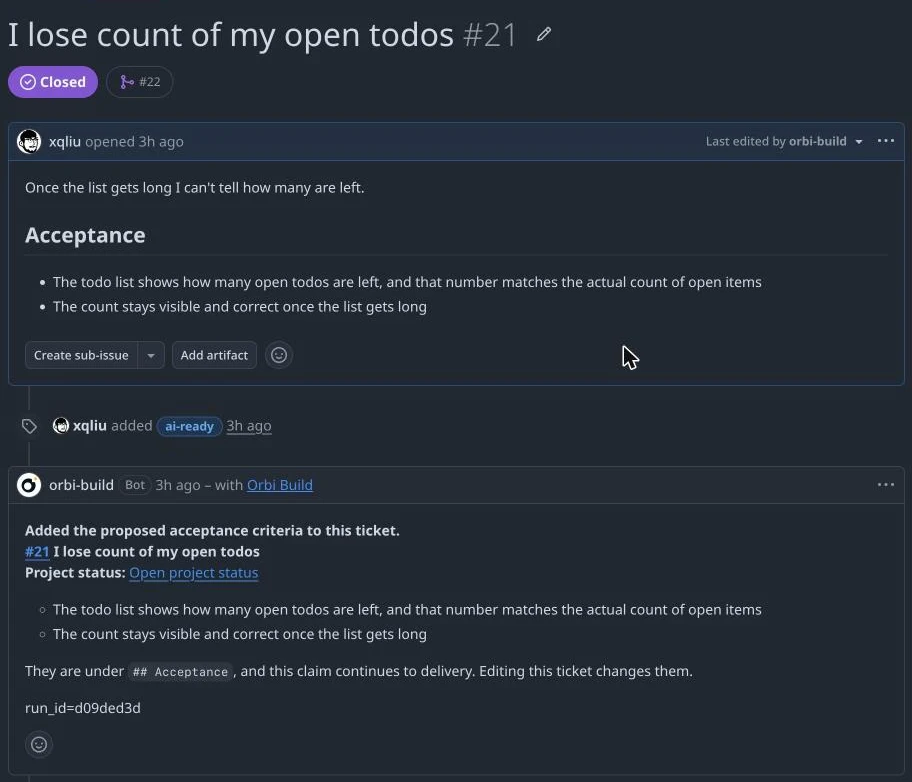
Issue #21 was titled "I lose count of my open todos". Its whole body was one sentence:
Once the list gets long I can't tell how many are left.
Three and a half minutes after it was opened, at 23:58:28 UTC, Orbi had claimed it and written two acceptance criteria into the Issue:
- The todo list shows how many open todos are left, and that number matches the actual count of open items
- The count stays visible and correct once the list gets long
The second criterion keeps the situation the person described, a long list, which a quick fix could easily ignore.
Four seconds later a coding session started from the amended Issue. PR #22 opened at 00:00:12 UTC on 20 November, changing index.html and two test files (+28/−1). The review session checked it against the two criteria and CI, and Orbi merged it after one review round at 00:03:22 UTC, 8 minutes 26 seconds after the sentence was written.
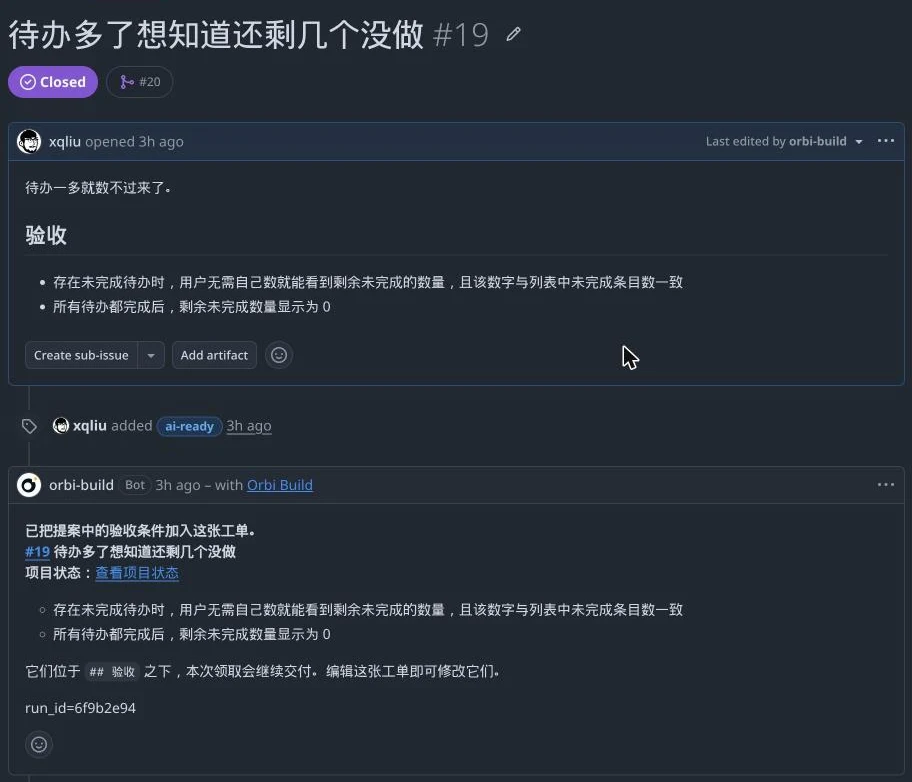
Two more requests went the same way. #19 asked for the same count in Chinese ("待办一多就数不过来了。", roughly "once there are many todos I can't keep count"). #25, "Let me clear the whole list", said only "The list is a mess and I want to start over."; its review session fixed one finding on the same branch and then passed it, all within one review round.
Swipe horizontally to see all columns.
| Request | Opened | Criteria added | Merged | Opened to merged |
|---|---|---|---|---|
| #19, todo count (Chinese) | Nov 19, 23:46:05 | Nov 19, 23:48:42 | Nov 19, 23:52:52 | 6 min 47 s |
| #21, todo count | Nov 19, 23:54:56 | Nov 19, 23:58:28 | Nov 20, 00:03:22 | 8 min 26 s |
| #25, clear the list | Nov 20, 00:20:07 | Nov 20, 00:23:38 | Nov 20, 00:30:02 | 9 min 55 s |
Times are UTC in 2026; "Opened" is when the Issue was created and "Merged" is when its pull request merged. The gap before "Criteria added" includes waiting to be picked up.
The criteria come back in the repository's configured message language, not the language of the request. The demo repository is set to Chinese, which is why #19 got Chinese criteria; I switched it to English messages for #21 and #25.
Who sees an edit, and when
The criteria Orbi writes are a proposal you can edit, and edits keep working after the coding session has started. While it runs, Orbi checks the Issue body every 60 seconds by default. When someone with write access changes it, Orbi restarts the coding session with the new text, up to three times by default. After that Orbi says on the Issue that the correction was not applied, and the running session carries on with what it has; review still reads the latest body. The review session reads the current Issue body fresh on every review round and treats it as the authoritative acceptance criteria, so the review checks whatever the Issue says at that point.
Editing mid-run costs a restart, though, and in #21 the coding session started four seconds after the criteria appeared. If the exact definition of done matters to you, the cheaper path is to write your own acceptance criteria into the Issue before you add ai-ready; if they give a concrete way to tell done from not done, Orbi uses them instead of proposing its own.
When one request is really two
A request in Orbi Cloud's own repository on 18 November asked to make the test suite faster in two ways: stop loading the test database in every test file, and run more tests in parallel on CI. At 17:26:06 UTC Orbi split it into two child Issues, one for each change, without anyone asking it to. Each child got its own acceptance criteria and its own delivery, and both were merged the next day. That repository is private and writes Chinese messages:
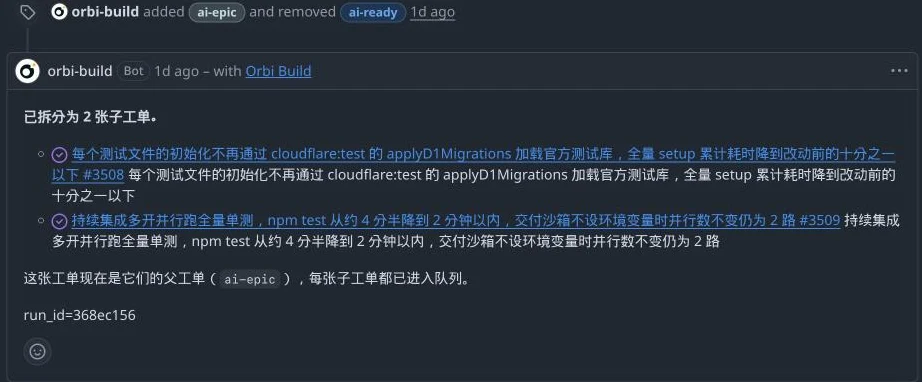
The children are GitHub's native sub-issues, and Orbi links them before queuing them. A split always has at least two. If one child depends on another, Orbi records it with GitHub's native blockedBy relationship, so the order is visible on GitHub. Children inherit the parent's milestone and its p0 or bug labels. Splitting this way used to wait for a maintainer to reply /orbi split; since engine v0.7.44 Orbi does it itself whenever the check is on (always, on Orbi Cloud).
Questions while drafting
"Write a request" is the page in Orbi Cloud where you describe a change in a sentence and Orbi reads your repository and drafts the Issue. While drafting, Orbi sometimes reaches a decision with a recommended option. In that case it takes the recommendation and records what it chose and why under the Issue's Assumptions section; only decisions without a recommendation come back to you as questions. If your message only asks for an explanation, you get an answer and no Issue is created.
Writing a request Orbi can deliver
- Say what you want to see, such as the number of todos left or an empty list after clearing. A visible result is what Orbi turns into acceptance criteria.
- If you already know a request has separate parts, open separate Issues. You decide the order: mark the later one as
blockedBythe earlier one on GitHub, or addai-readyto the second only after the first merges. - If the definition of done matters, write the criteria yourself before adding
ai-ready. You can still edit them later, at the cost of a restart.
What happens after delivery starts and then stops is covered in When an AI coding run stops and needs your answer.